



Albert G. Storace reviews the Aurora production of La Forza del Destino, performed on 11th October 2025.
Photos by Anthony Grech.
Since the first opera performed at the Aurora Opera House in January 1977, Verdi’s opera La forza del destino had only been performed there just twice.
The first was on 13 October 2007 while the second time was yesterday just two days short of 18 years since that first Aurora performance of one of Verdi’s most doom-laden operas.
Yet the doom and gloom of this tragic story is clothed in beautiful, unforgettable music. Solos, duets, trios, full ensemble singing and richly peppered with (mostly) robust and boisterous choruses.
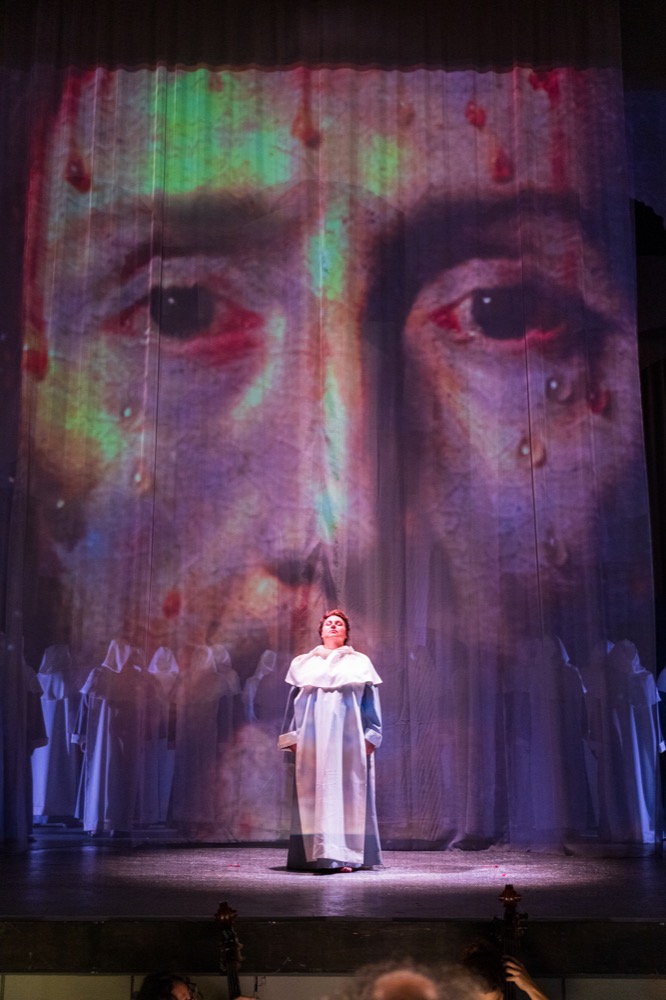
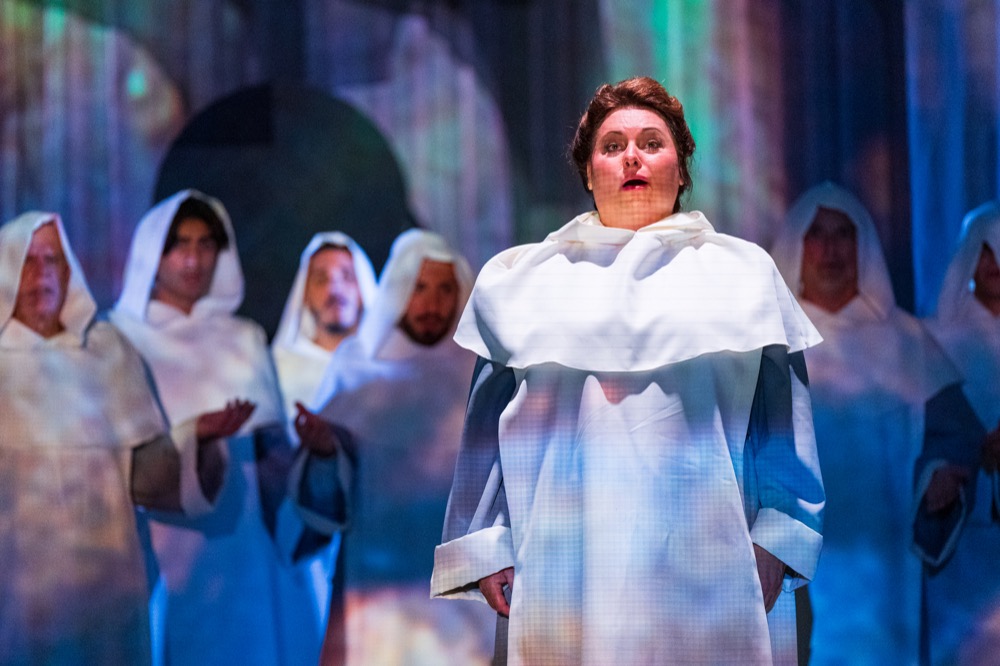
All of this was there in this singular performance with a modern touch about it, which worked well for Riccardo Buscarini’s stage direction. The plot may be a little bit crazy with the shifting of action back and forth between Spain and Italy, not to mention the rather unbelievable failure of Carlos de Vargas to recognise Àlvaro, whom he continuously and wrongly believes has murdered his father. Yet even swears an oath of friendship to the man who saved his life in battle.
That is opera: make-believe all the way. Still, the music, singing and acting make one forget that and get involved into a story one already knows how it is going to end up. The magnificent overture prepares the way with its various themes and motifs.
The cast was an international one, with Ukrainian soprano Ludmyla Monastyrska as the ill-starred heroine, dogged by misfortune all the way. She sang and fully acted the part with a beautiful powerful and well-controlled voice. So it was from her aria in Act 1 scene and later on in Madre pietosa Vergine and her last poignant Pace, pace mio Dio.
Italian tenor Stefano Secco’s Don Álvaro, despised by Leonora’s father the Marquess of Calatrava and her brother Carlos because of his mixed racial background suffers humiliation has to run for his life. He believes his Leonora is dead and often wishes he were dead too in order to end his misery. Like the soprano he was consistently on top from from beginning to end. His peak was to my mind Tu che in seno agl’angeli. This was preceded by a lengthy introduction which featured some great playing by clarinettist Javier Zamora Morano. Also in the beautiful duet with Carlo: Solenne in quest’ora; in their subsequent confrontations; final provocation and fatal duel.
Greek (Rhodiot) baritone Dimitris Tiliakos had the right menacing presence, highly vindictive pursuer madly obsessed with seeking his sister’s and her lover’s death. He refuses to relent, to believe that Àlvaro and his sister were responsible for the death of their father. He was terribly good at being terribly bad. His Urna fatal del mio destino was on peak form as in all the opera.
Italian mezzo-soprano Cristina Melis interpreted the role of Preziosilla who turns up twice in Spain and Italy. She is like a mixture of gypsy and regimental mascot with her lauding of the “beauty of war”. It was well-interpreted and full of panache. With male chorus she excelled as they did too in the unusual onomatopoeic piece Rataplan.
Japanese bass-baritone Hidenori Inoue had a commanding and dignified presence especially in all his interaction, whether with Leonora, Àlvaro as well as with Melitone.
The latter role as the impatient and irritable friar is the only rather comical contrast to the disasters all around it earned Italian baritone Tiziano Bracci well-deserved plaudits for his performance which was sung without the usual cuts which prevail in most productions of this opera.
Minor roles were those of the Marquess of Calatrava, (Italian bass Davide Procaccini) accidentally and fatally wounded but lives long enough to curse Leonora. There was Italian tenor Francesco Napoleoni as Mastro Trabucco. Bass Andrea Carcassi took the double roles of Alcalde and mitary surgeon. Maltese mezzo-soprano Nicole Vassallo did well too as Curra, Leonora’s faithful assistant.
Mara Pieri was costume designer and Giammaria Farina’s open set design with sheer partitions enduring sleek changes of ambience. The fine lighting design was Moritz Zavan Stöckle’s.
A numerous production team ensured smoothly flowing production. The chorus was also a department on top form, trained by Chorus Master Colin Attard. He was also at he helm of the Malta Philharmonic Orchestra (leader, Marcelline Agius), a fine team which was also on great form and produced the desired results.
The opera was sponsored by Arts Council Malta, the Minstry for Gozo and Planning and Bank of Valletta.