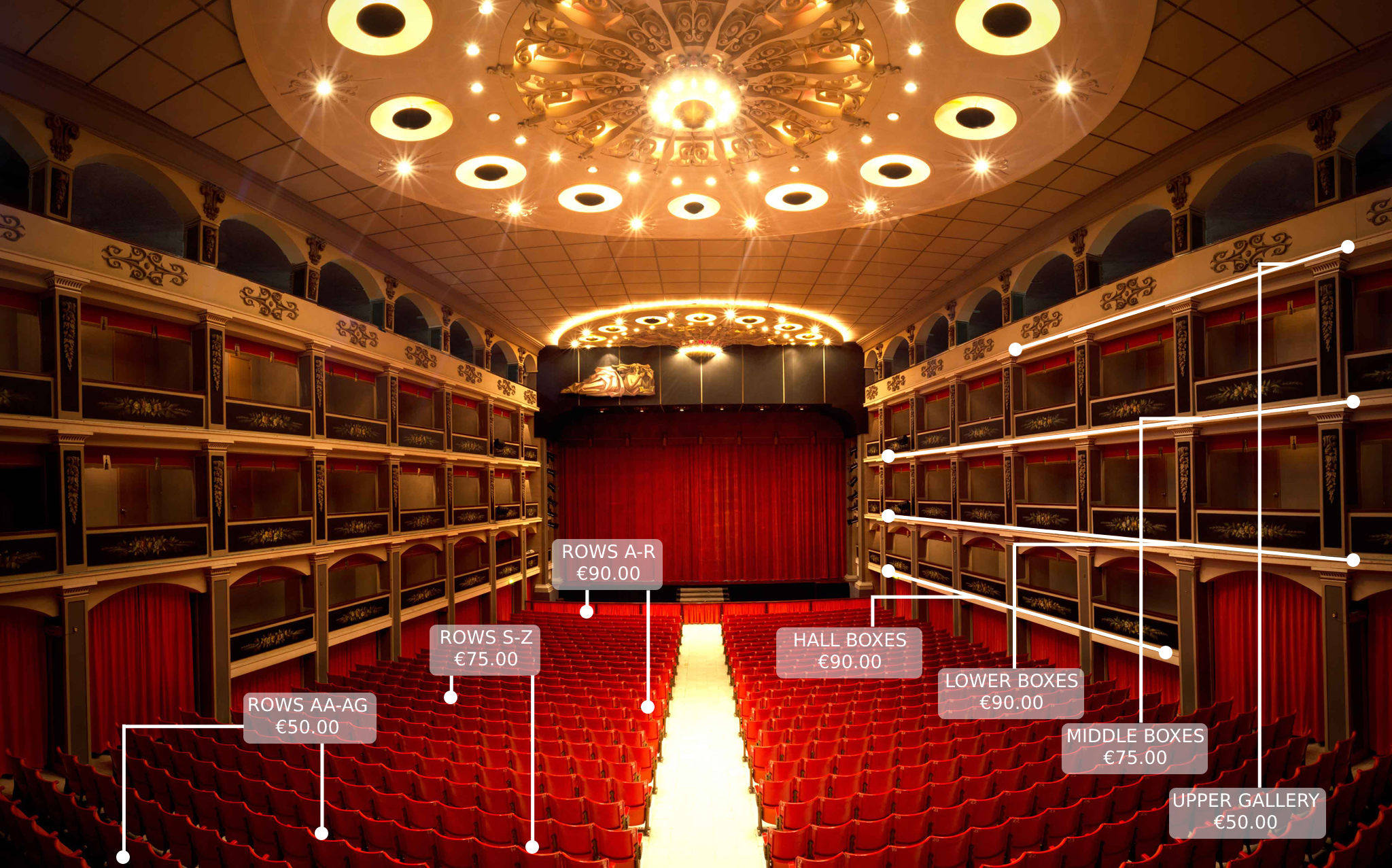




Cecilia Xuereb reviews the Aurora production of La Forza del Destino, performed on 11th October 2025.
Photos by Anthony Grech.
Verdi’s La Forza del Destino is a complex masterpiece. On the face of it, it might appear to consist of a string of glorious arias. It covers a vast canvas, from the personal to the social. It is about the tragedy of the three main characters – Leonora whom circumstances prevent from attaining happiness and peace, Don Carlo who is bent on avenging his family’s honour and Alvaro, the victim of Don Carlo’s vengefulness over a crime that was not a crime. But glimpses of popular life complement the simple and even banal feelings of the protagonists, and make their own implicit comment on the personal drama. It is not an easy opera to stage and the Teatru tal-Opra Aurora’s production of this opera in Gozo last week showed that in spite of its rambling libretto and the power of coincidence rather than the destiny of the title, the opera is essentially a valid work of music drama.
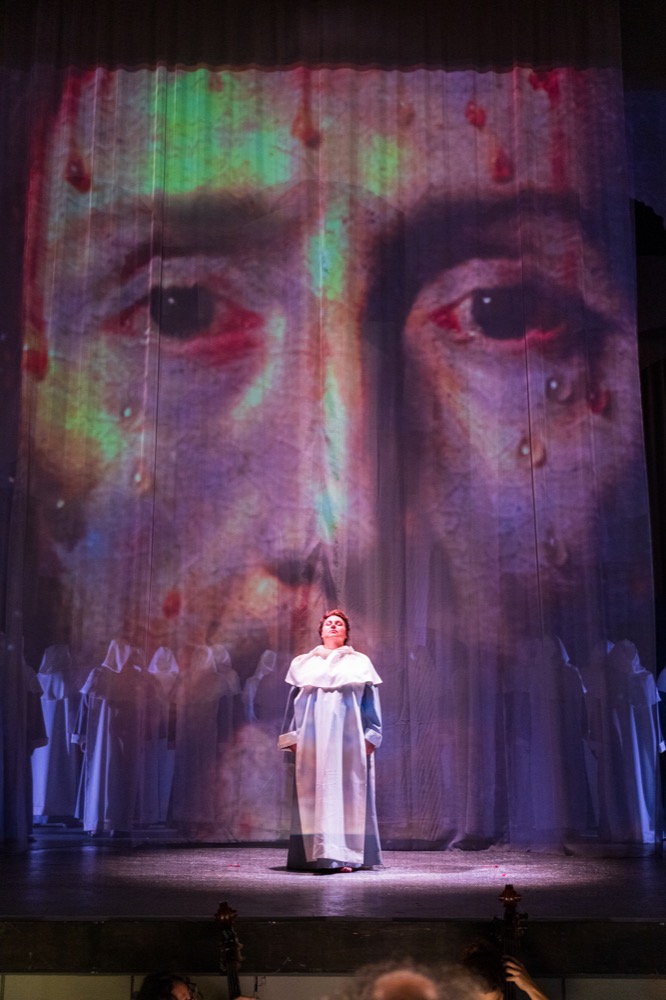
The artistic director, Riccardo Buscarini, presented the drama as the struggle between fate and faith. “Destiny”, he wrote “guides and torments characters: it designs and erases their path, offering no clarity to the protagonists”. “Faith can be a shelter too, a defence against the flux of life,” to perhaps help them hide behind a mask in order to survive. The drama is acted on a bare stage with minimum furniture, against veils of fabric that reflect the light and let it pass through, “like thoughts that penetrate the soul”. “The space does not impose itself. Rather it reveals itself” allowing “itself to be inhabited by mystery; to be traversed by destiny” (set designer Gianmaria Farina). The effect was elegant, functional and while allowing plenty of space for the big scenes allowed the audience to concentrate their attention on the more personal parts of the drama.
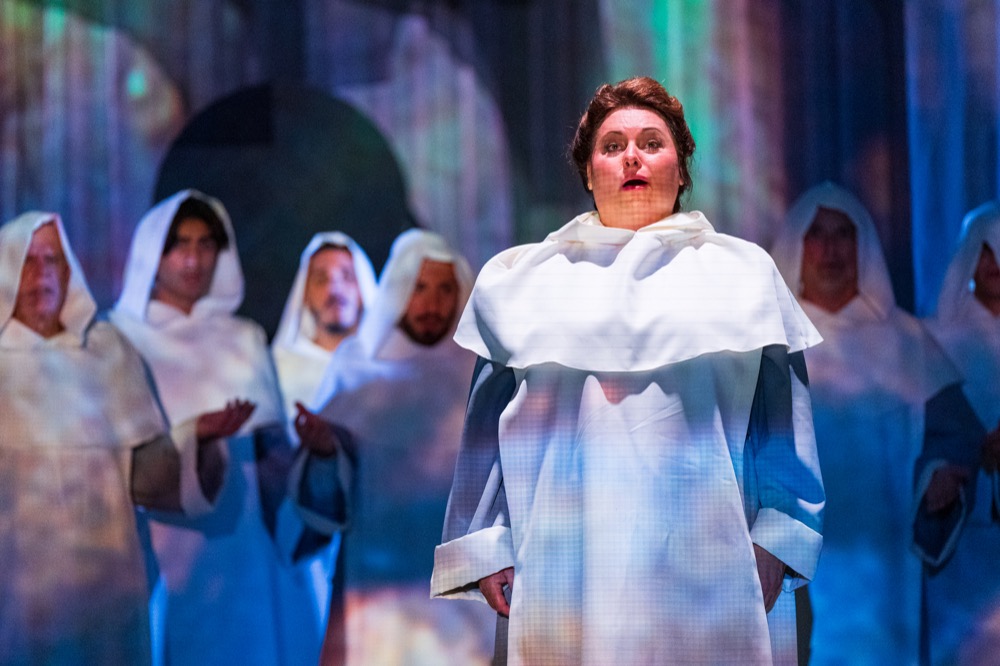
On the other hand it blurred any sense of the action moving from Spain to Italy and back to Spain, and from the aristocrat’s home to the village and the monastery, and finally to the cave where Leonora hoped to find Peace. This was up to a certain extent compensated by Maria Pieri’s costumes, jewel-coloured in the opening scene, vivid but earthy colours in the scenes with the villagers and the grey-white tones of the friars which made their own statements. It is also about the struggle between “fate” and “faith” as seen in the struggle inside Alvaro and his conflict with Carlo. The role of Padre Guardiano, who accepts Leonora’s choice to live as a hermit in pursuit of redemption and dominates the final act, highlights the strength of “faith”, which ultimately remains powerless against “fate”.
Performing the overture against a drawn stage curtain – something that has become quite rare in recent opera productions – allowed the audience to concentrate on the music which is vividly exciting, dominated by the “fate” music which opens the piece and references to important moments of the drama. The curtain opened to reveal Leonora bidding farewell to her father. Musically in this work Verdi was deliberately continuing to move away from the strict aria form of contemporary opera towards a greater fluidity and an apportioning of more orchestral and melodic interest to the recitative. However, after the excitement of the overture the opening scene came across as rather tame. All the voices, including that of the soprano, needed some time to warm up.
Leonora was played by soprano Liudmyla Monastryska, who showed she has power and stamina for this demanding role. Leonora is one of Verdi’s most ambivalent characters. Even while she is, or should be, happy to be running away with her lover she is overcome with remorse at the idea of leaving her father and her home. In her first aria Me pellegrina ed orfana she pictures her friendless lot in a foreign country. Even while her heart is bursting with joy she is weeping. Monastryska gave a very convincing performance, both dramatically and vocally. Although her singing might not have shown her bravura in the opening scene, in the second act her vocal control was superb both in her long aria in which she asks forgiveness for her sin and her duet with Padre Guardiano. She ended the scene with a moving rendering of the hymn to the Virgin, La vergine degli Angeli. Another highlight of her performance came in the last act with the aria Pace Pace, mio Dio, in which, in long phrases of supplication, she prays for the peace that she has never known.
Tenor Stefano Secco played Alvaro, Leonora’s lover. Doomed from the very beginning by the accidental death of Leonora’s father, in his chance meeting with her brother on the battlefield, he portrays more than any other character the power of destiny as opposed to that of faith. His voice was rather uneven and sounded better in the higher register where he showed more power. His singing was often stylish but he lacked the emotional range to portray Alvaro’s complex and tragic journey.
The villain of the piece, Don Carlo, Eleonora’s brother, bent on getting revenge at all costs, was played by baritone Dimitris Tiliakos. He painted Don Carlo di Vargas’ anger over a crime that wasn’t even a crime in vivid vocal colours. There was a sense of villainy in his cry of Finalmente, when Alvaro agrees to a duel. Even while one is repelled by his character one cannot help being drawn by his power. He made light of the high tessitura that extended the range of his voice. In his duet with Alvaro in Act IV, one of the finest and most expressive duets for tenor and baritone which Verdi had written to date, the contrast between the tenor’s urgency and the baritone’s steely intransigence was wonderfully brought out in both music and gestures.
The rich sonorous voice of bass Hidenori Inoue in the role of Padre Guardiano made the case for faith and repentance, making this the most Christian of all Verdi’s operas.
Among the other characters, baritone Tiziano Bracci was a fine comic as Fra Melitone relieving the tension of the drama. Mezzo soprano Nicole Vassallo as Curra, tenor Francesco Napoleoni as Mastro Trabuco and mezzo-soprano Cristina Melis as Preziosilla distinguished themselves in their respective roles, of Leonora’s maid, a muleteer and a gypsy.
The Aurora chorus was in excellent form throughout but especially so in the pilgrims’ chorus in Act II.
Musically this performance was marked by the light and shade provided by the wide range of dynamics that every individual singer, as well as the chorus, put in his/her performance while Colin Attard, directing the Malta Philharmonic Orchestra, gave a stirring account of Verdi’s energetic score.