


a Violetta of unusual emotional depth
Those boots are made for walking….
**In brief:** The designers had one clear fetish in last night’s La Traviata at Gozo’s Aurora Theatre. And no question what that was – ankle boots. Think Nancy in Oliver. There were one or two other strange costume choices, but overall it was a moving, polished celebration of Gozo Opera Festival’s fiftieth year. Zuzana Marková’s Violetta stood out for her vocal agility, emotional depth and finely judged acting, making the heroine’s decline heartbreaking. Colin Attard led the Malta Philharmonic Orchestra and Aurora Opera Chorus with sensitivity, and the creative team’s elegant staging kept Verdi’s tragedy intimate and compelling. But the Aurora theatre has work to do in a few crucial areas to make an evening there enjoyable – see bitchy paragraphs at the end.
## In Detail
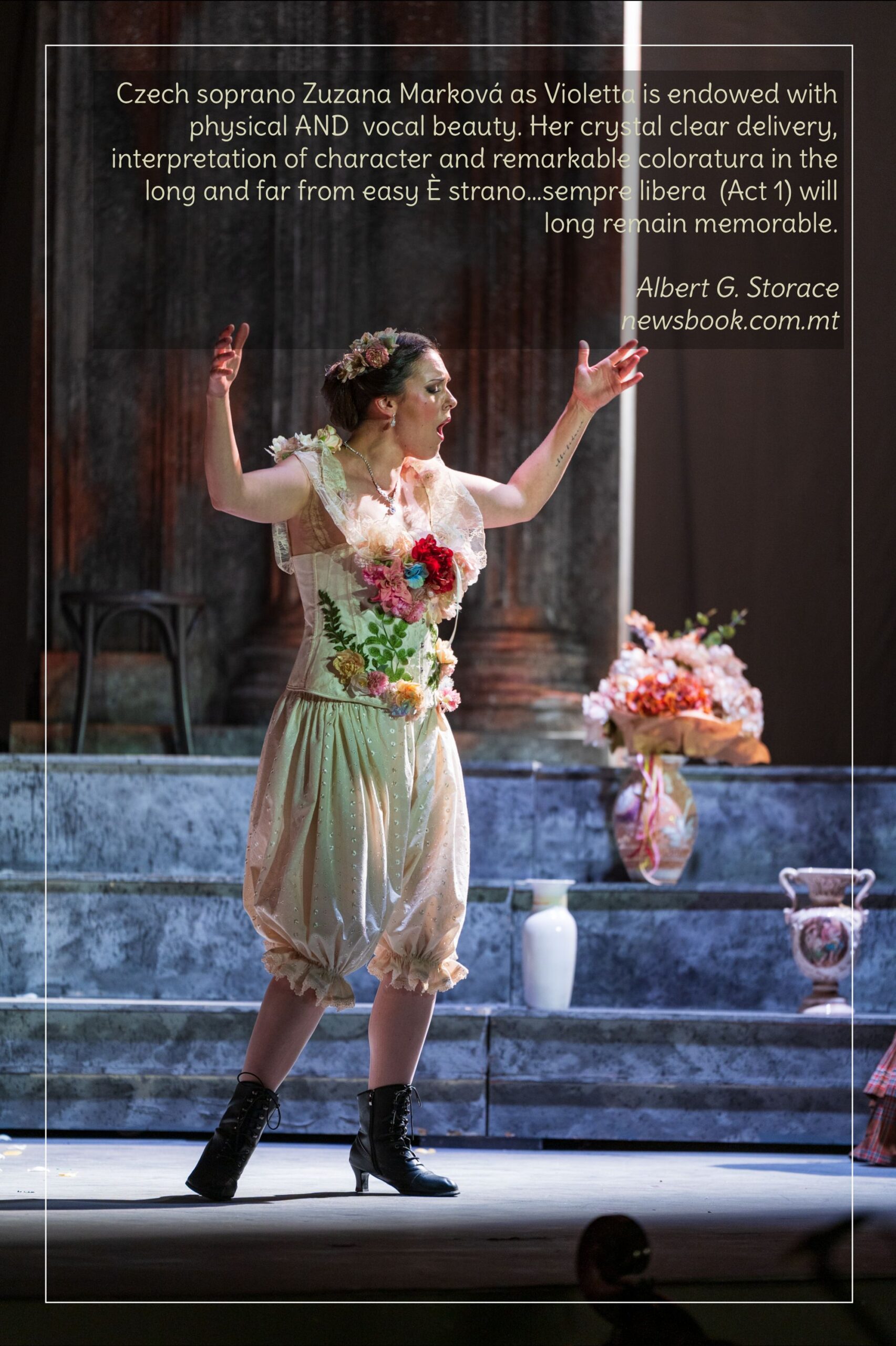
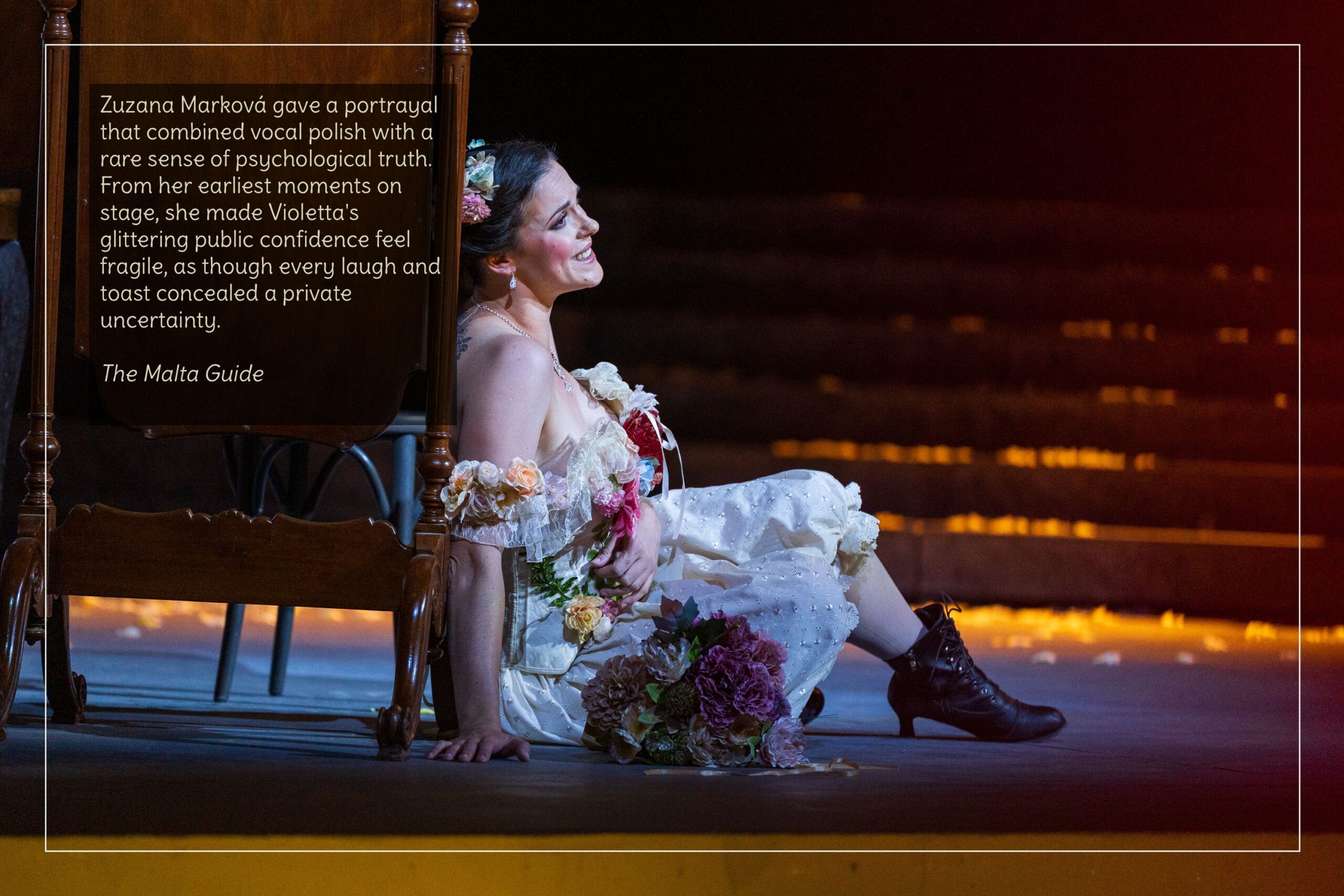
Last night’s performance of Verdi’s La Traviata at Teatru tal-Opra Aurora was an evening built around a Violetta of unusual emotional depth: Zuzana Marková gave a portrayal that combined vocal polish with a rare sense of psychological truth. From her earliest moments on stage, she made Violetta’s glittering public confidence feel fragile, as though every laugh and toast concealed a private uncertainty.
Marková’s singing grew more affecting as the opera progressed. In the early Paris scenes, her voice had brightness and agility, but she resisted turning Violetta into just a display of technical fireworks. Instead, each ornament and high note seemed motivated by character. Her account of Violetta’s inner conflict was especially convincing: the excitement of possible love, the instinct to protect herself, and the growing realisation that Alfredo’s devotion might offer a different life. By the final act, her sound had become quieter and more exposed, and the effect was heartbreaking without ever feeling manufactured.
Her acting was equally strong. Marková used stillness as effectively as movement, letting Violetta’s exhaustion register in small changes of posture and expression. In the later scenes, she conveyed a woman who understood exactly what was being taken from her, yet continued to behave with grace and courage. This was not simply a beautifully sung Violetta; it was a fully imagined one.
Up against this colossus, we can perhaps forgive Raffaele Abete’s Alfredo for being a little quiet at first. But as he warmed to his role he became an ardent, youthful presence, demonstrating he is a tenor capable of both tenderness and impulsive force. He was particularly persuasive when Alfredo’s humiliation turned into public fury in Act II. The cruelty of that moment made his eventual remorse feel earned rather than merely conventional.
Dimitris Tiliakos brought stature and subtlety to Giorgio Germont. Rather than presenting Violetta’s adversary as a cold enforcer of social respectability, he revealed a father caught between duty, prejudice and genuine feeling. His scenes with Marková gained from this ambiguity, and his eventual recognition of her sacrifice carried real weight.
The supporting singers strengthened the production throughout. Veteran Andriana Yordanova gave Flora lively charm, while Clare Ghigo’s Annina provided warmth and quiet loyalty. Alan Sciberras, Noel Galea, Louis Andrew Cassar and Hidenori Inoue each made their contributions count, giving the smaller roles clarity and personality rather than treating them as background figures. Cassar always has stage presence and I long to see more of him.
Colin Attard led the Malta Philharmonic Orchestra with a keen sense of Verdi’s contrasts: the sparkle of the opening festivities, the urgency of the confrontations, and the hushed intimacy of the closing scene. The Aurora Opera Chorus contributed energy and precision, helping the social gatherings feel populated and alive.
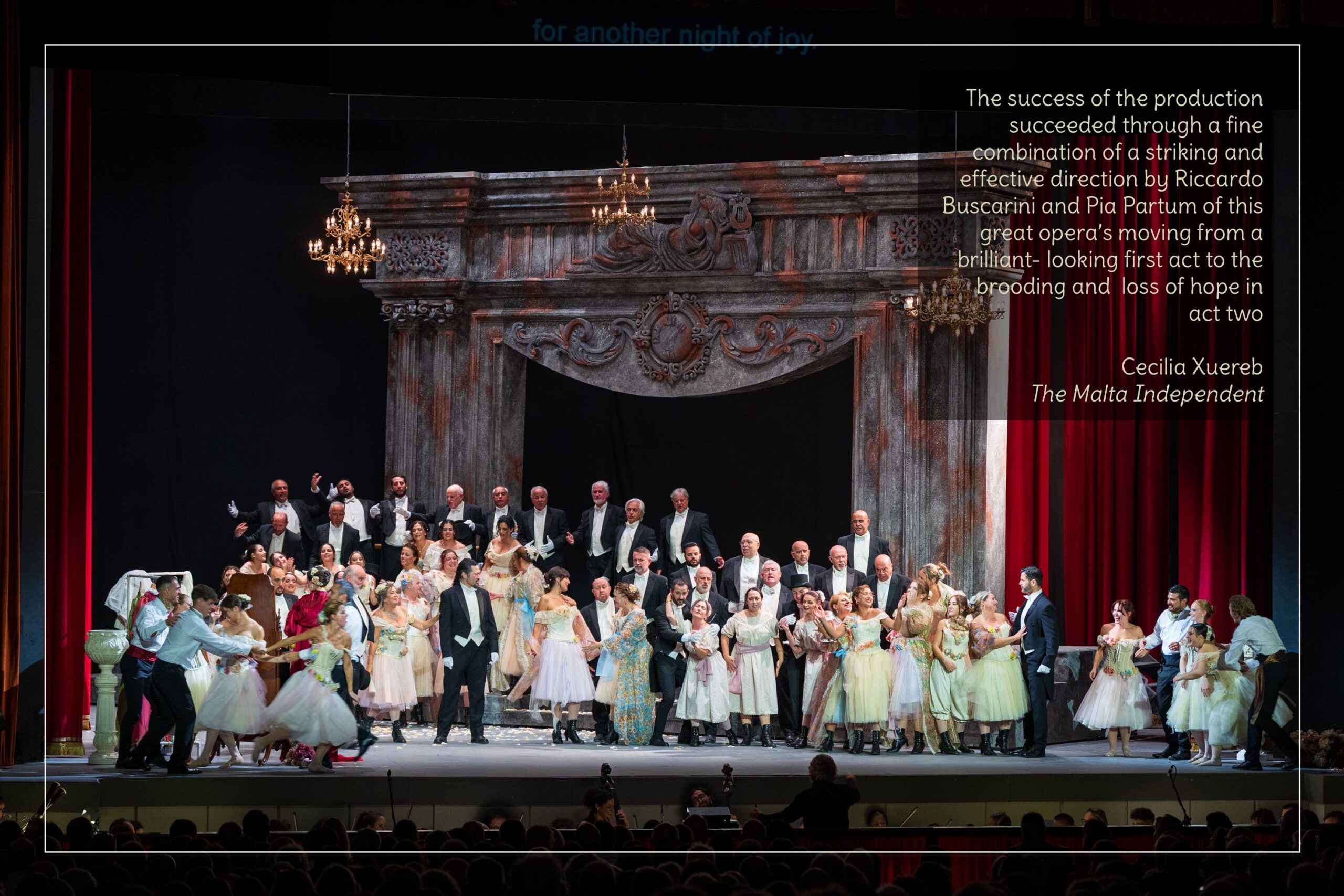
Riccardo Buscarini’s direction, developed with Pia Partum, kept attention firmly on the relationships at the centre of the story. Giammaria Farina’s designs supplied elegance through one device – the stage was dominated by an enormous triumphal arch…or was it a marble fireplace? This worked well for the party scenes but was wisely dismantled for the intimacy of the death bed scene in the final act. Overall, the production’s visual richness made Violetta’s loneliness all the more pointed: amid beauty, wealth and company, she remained profoundly alone.
## “She’s a courtesan, not a common prostitute…”
Mara Pieri’s costumes also had their moments – not least the chorus like an endless parade of Degas dancers. But there were also some brave choices. Apart from the ankle boots, the bizarre notion of Violetta receiving all the party guests in her underwear. She’s a courtesan, not a common prostitute. And would Germont, a stickler for etiquette, really turn up at a stranger’s house in his shirt sleeves?
This was an accomplished and deeply felt La Traviata, distinguished above all by Marková’s moving, intelligent and vocally assured Violetta.