


A Spectacle to be remembered and treasured
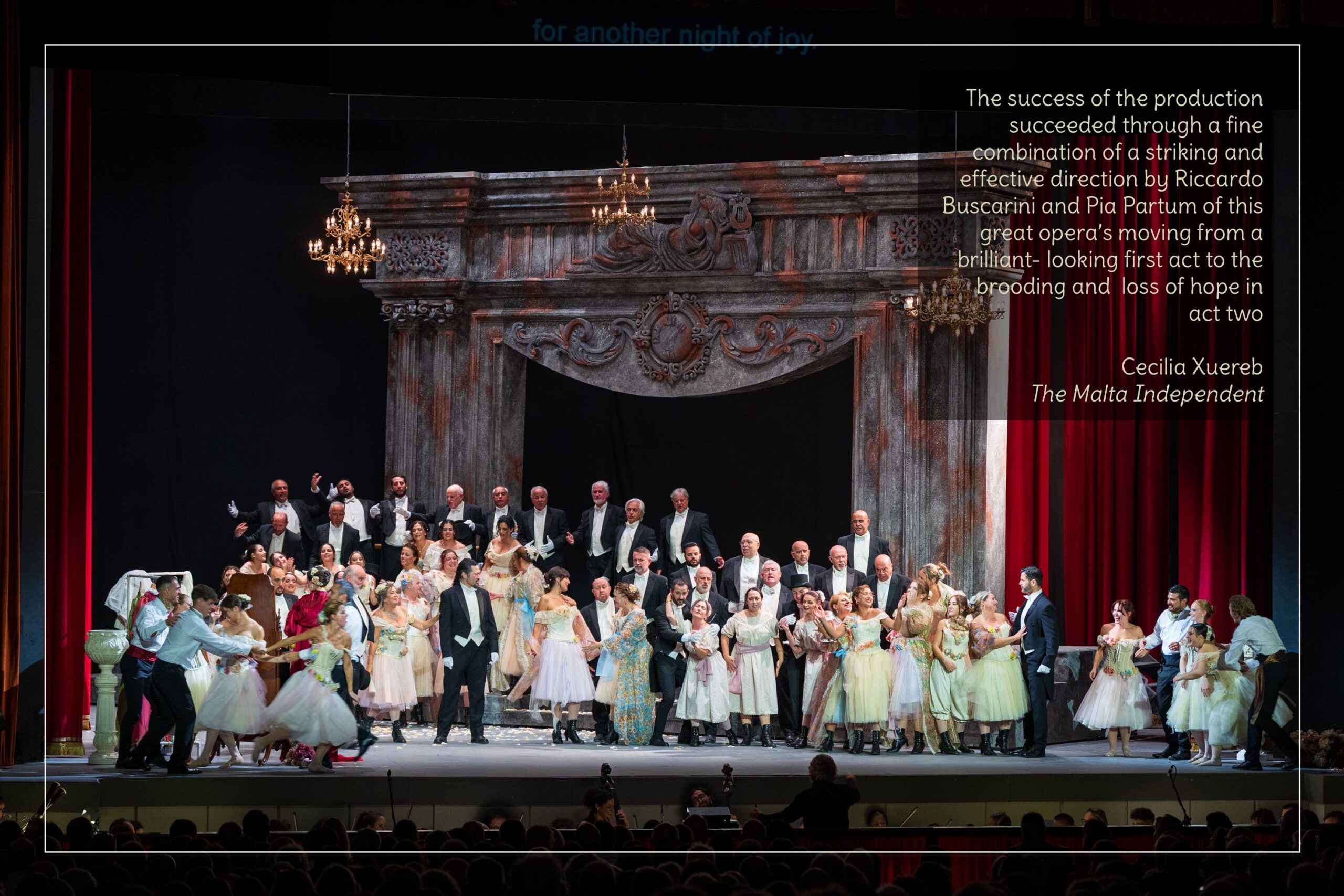
The Teatru Aurora in Gozo continues to aim high wrote Dr Michael Caruana the President of the Leone Philharmonic Society and this third generation of mostly volunteers have certainly given the audience a spectacle to be remembered and treasured with the production of Verdi’s opera La Traviata.
Cecilia Xuereb,
The Malta Independent
Sunday 8th November 2026
The success of the production succeeded through a fine combination of a striking and effective direction by Riccardo Buscarini and Pia Partum of this great opera’s moving from a brilliant- looking first act to the brooding and loss of hope in act two. This is in turn followed by a new frivolity suddenly ending in an act of great cruelty by a lover to his ex-mistress, and concluding with a dark act. This finally leads on to the death of the blameless Violetta, and the discovery by Alfredo of the innocence he had so greatly misunderstood. This pilgrimage was made to look strong by Gianmaria Farina’s excellent set design, with its magically vanishing units, and ending with the symbolic collapse of the high bourgoeis set into the poverty of the room in which the tragic Violetta so touchingly dies.
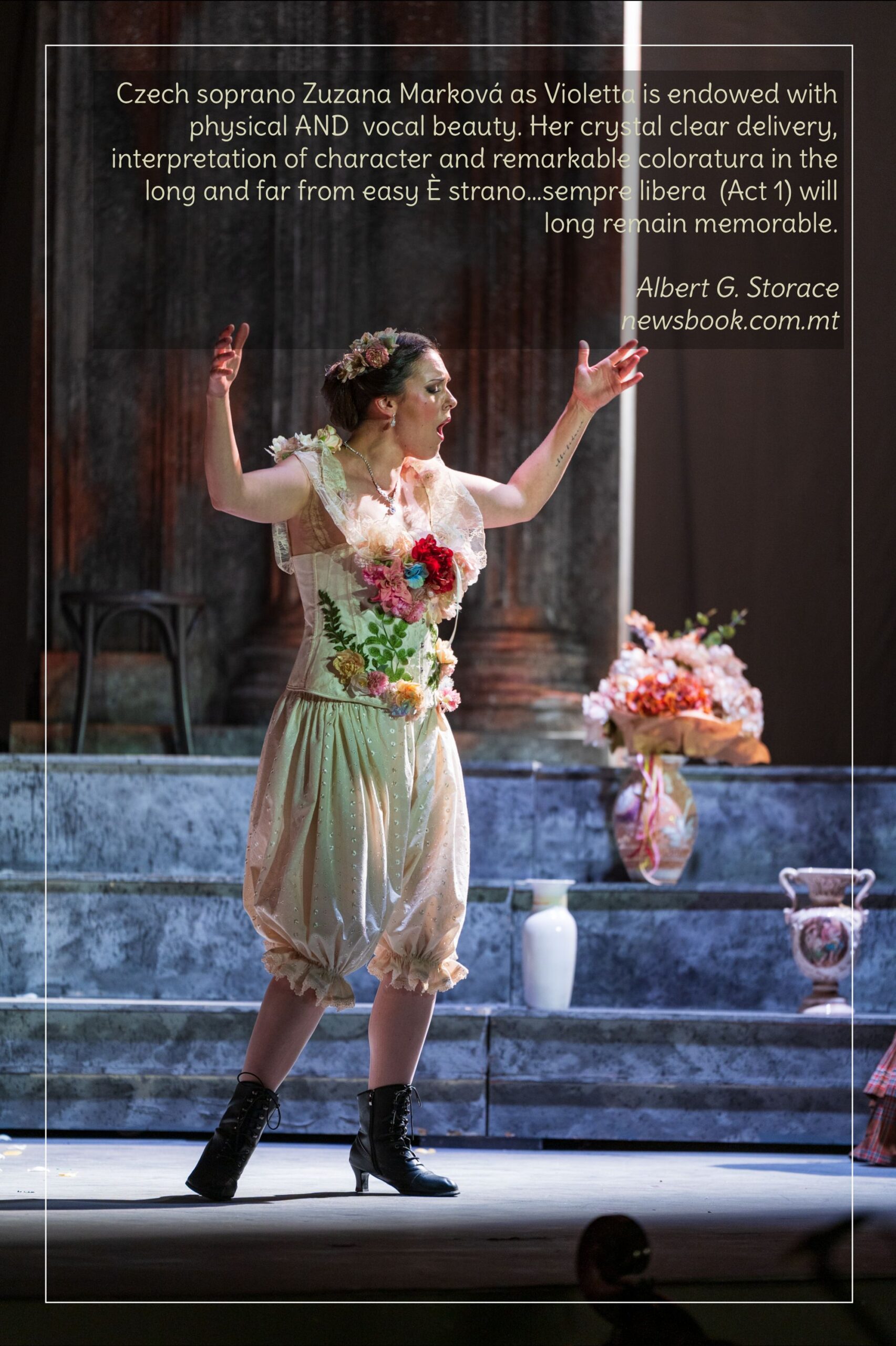
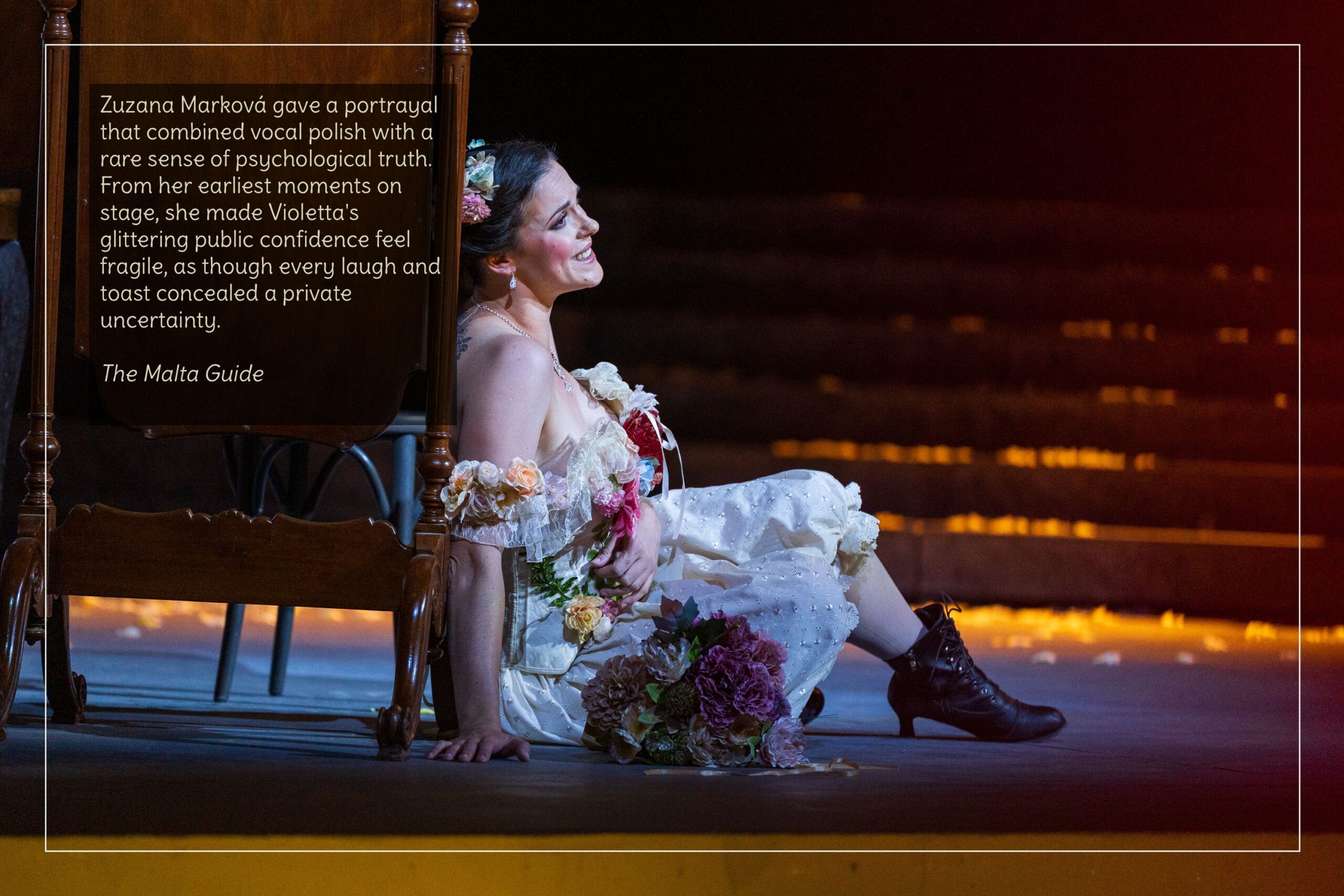
This interpretation of the story differs from the more popular interpretation of Violetta as a frail woman redeemed by love, but here she is seen as a woman broken by love and respectability. “È che l’amore è una tragedia per me?” she asks in the first act in a kind of foreboding of what lies in store for her. It is the tragedy of a woman who loses her power as a woman to morality and respectability. This interpretation was fully taken up by a superb soprano, Susana Markova, whose splendid singing and acting accompanied the direction to the very end. Vocally Violetta’s is a part that requires both a coloratura soprano, particularly in Act 1, and a more lyrical voice required by the music in Act 2 sc.1 and Act 3. The latter two scenes are dramatically the two key scenes of the opera. Her long duet with Germont, Alfredo’s father as he undermines her strength as a woman, is sung by another splendid singer in a class of his own. In the last act the main part is her duet with Alfredo who returns to ask forgiveness. It is not love but her impending death that dominates the scene. The pathos in both her voice and her acting was palpable and passed on to all the other characters on stage.
Baritone Dimitri Tiriakos has a fine Verdian voice. In La Traviata Verdi gave him a number of fine arias that he sang with an expressive ease with a wide dynamic range that conveyed his moving from an accuser to a pitying but staunch moralist was full of feeling and exploited his wide dynamic range. He failed to separate Violetta and Alfredo but the change in him was utterly convincing.
Tenor Raffaele Abete’s voice does not rank in the class as the soprano’s or the baritone’s but both his singing and his acting made a fine contribution to the musical and dramatic success of the production.
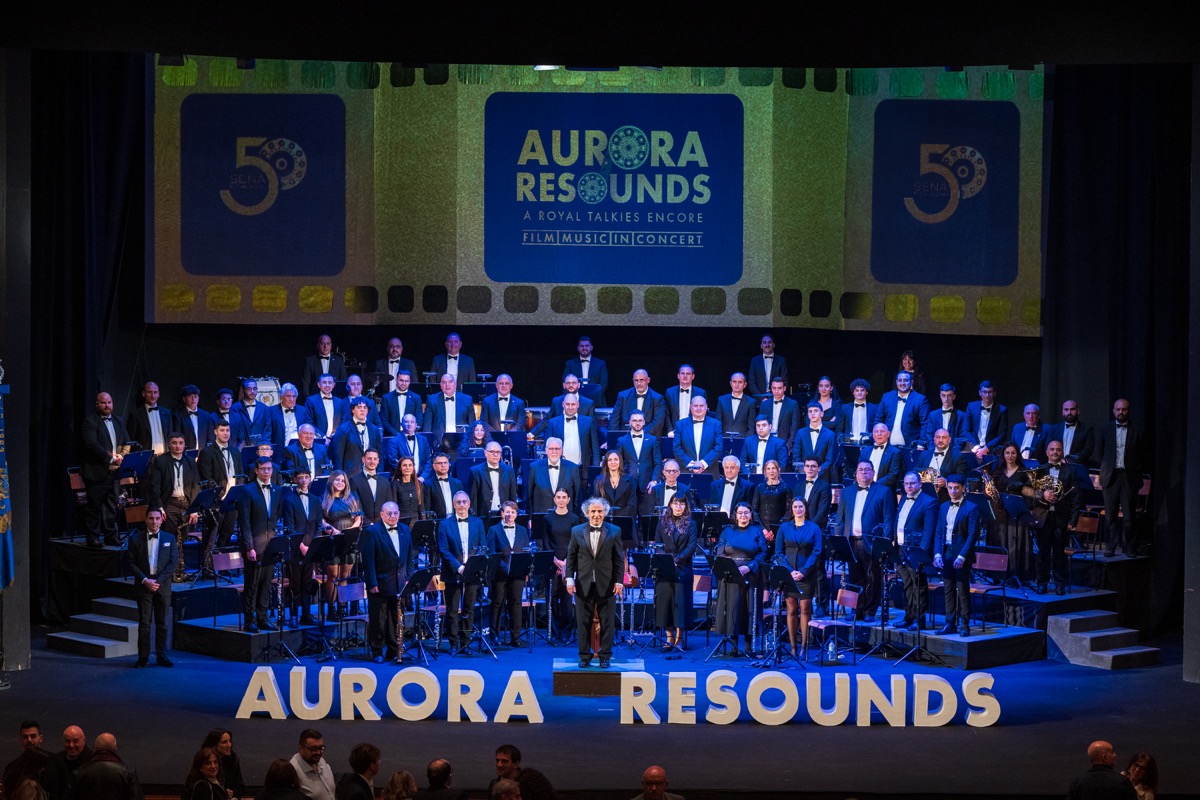
In spite of their familiarity with the score the Malta Philhmaronic Orchestra followed conductor Colin Attard’s revisiting of the score in a performance in which both tempos and dynamics worked hand in hand with the directors’ approach to the drama.
Secondary parts were sung by mezzo soprano Adriana Yordanova (Flora), Alan Schiberras (Gastone), bass-baritone Louis Andrew Cassar (Barone), bass Noel Galea (Marchese), and tenor Hidenori Inque (Doctor Grenvil). These, as well as a number of minor roles were all well sung and like the Aurora Opera Chorus, as well as the dancers, immersed themselves completely in the production.